
Research & Internships
Research & Internships
Finding a Research Mentor
Students can find mentors who are researching questions that match their interests.
Off-campus research
Students are only a short commute from one of the nation’s largest concentrations of biotech firms, federal research labs and research hospitals. Explore research opportunities beyond the University of Maryland.
On-campus research
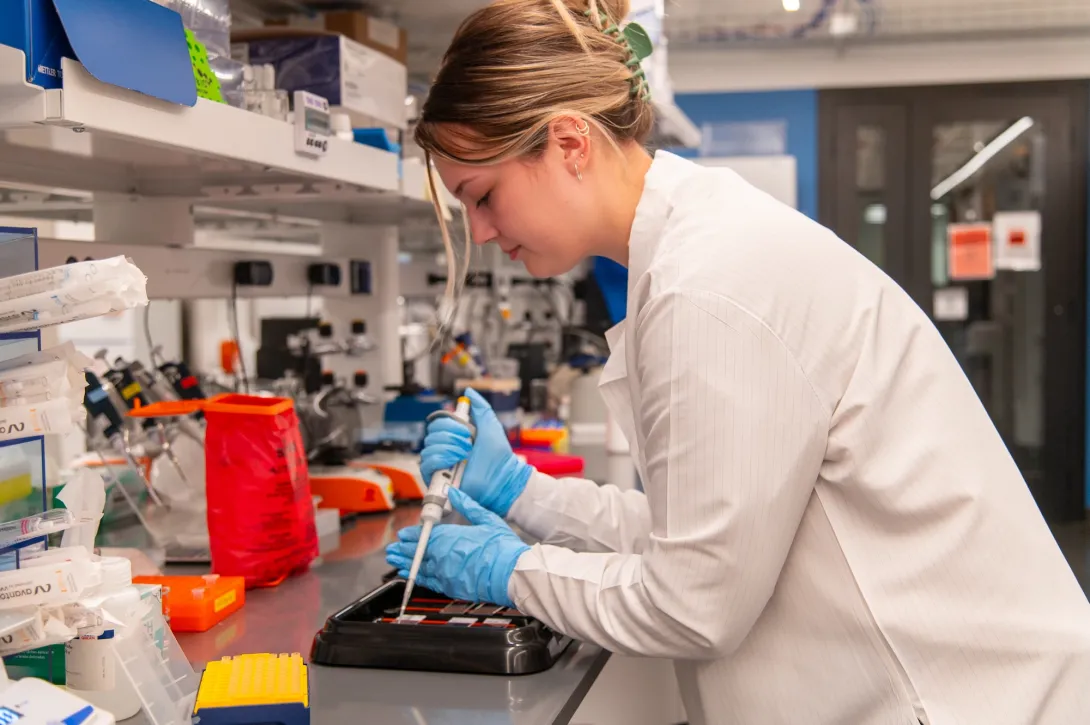
There are opportunities to do undergraduate research in world-class laboratories under the mentorship of renowned faculty researchers. Explore and connect with faculty members from the following departments listed below.
- College of Computer, Mathematical, and Natural Sciences: Astronomy, Atmospheric & Oceanic Science, Biology, Cell Biology & Molecular Genetics, Chemistry & Biochemistry, Computer Science, Entomology, Geological, Environmental, & Planetary Sciences, Institute for Bioscience & Biotechnology Research, Mathematics, Physics
- College of Agriculture and Natural Resources: Animal & Avian Sciences, Environmental Science & Technology, Nutrition & Food Science, Plant Science & Landscape Architecture, Virginia-Maryland Regional College of Veterinary Medicine
- College of Behavioral and Social Sciences: Anthropology, Hearing & Speech Sciences, Psychology
- School of Public Health
- Clark School of Engineering: Chemical & Biomolecular Engineering, Fischell Department of Bioengineering
Connecting with faculty members
- Ask around: Your current and past professors may be accepting students or know of any colleagues who are. Your academic advisor may also know of mentors who would be a good match for your interests.
- Contact potential mentors to determine whether they are interested in having you join their research program. In your first contact with potential faculty mentors, you should tell them your: year, GPA, relevant research experience and general interests or goals.
- Meet with potential mentors in person, tour their lab and speak to other students in the lab (both graduate and undergraduate) before making a final decision.
- Make an explicit agreement with your mentor that specifies your responsibilities and the days and hours you will work.
- (optional) Contact the coordinating advisor or undergraduate program director in the department to which your faculty mentor belongs to see about earning academic credit for your work.
Experiential Credit
Upper-level lab
BSCI379L, BSCI389L, BSCI399L (1-3 credits)
Some research at UMD labs can count towards the upper-level lab requirement.
- With the approval of their faculty research mentor, students who are already enrolled in BSCI379G, BSCI389 or BSCI399 can subsequently enroll in BSCI379L, BSCI389L, or BSCI399L and apply the two semesters of research credit towards the upper-level lab requirement of their Biological Sciences degree.
- To do this, submit the permission form to the appropriate departmental office—it can be filled out electronically prior to printing.
Off-campus research
BSCI349 (1-3 credits)
By permission only and restricted to biological sciences majors.
- Can be applied to the Biological Sciences enrichment category in PHNB, CEBG, ECEV, MICB and the additional credits category of GENB
- An opportunity for biological sciences students to pursue a research project in an off-campus lab
- To register, email bscique@umd.edu or contact the course instructors directly. Search BSCI349 in the Schedule of Classes (SOC) for the current instructors listed.
BSCI348R (1-3 credits)
Graded credit that may apply toward upper-level requirements (check with your academic advisor)
- This is specifically for students in the microbiology specialization or microbiology internships.
- Search BSCI348R in the Schedule of Classes for the current faculty sponsor.
- Contact the Department of Cell Biology and Molecular Genetics for any forms that must be completed
Faculty-mentored research
CHEM399, BSCI379, BSCI389, BSCI399 (credits vary)
Credit is assessed by one of the undergraduate directors—see contacts listed at the bottom of this page.
- Students can apply up to three (3) research credits toward the upper-level requirements of the biological sciences major.
- A total of eight (8) credits can be applied to a UMD degree.
- Students are able to complete more than eight credits of research, but only eight credits are applicable to the UMD degree.
- Students can register for one to three (1-3) credits of research in any given semester.
- Students can expect to work three to four hours a week while at a campus lab during the academic semester.
- In rare circumstances, students can register for up to four research credits in an academic semester.
Clinical internship (non-research)
The College of Behavioral and Social Sciences (BSOS) offers off-campus internship credit to students of all majors.
Academic credit can be earned for para- or pre-professional work with well-established organizations with regular and frequent supervision from experienced professionals. Get started on the Feller Center’s Internships for Credit webpage. Contact information will be listed there.
UNIV099 Internship Seminar
Non-credit course. Provides transcript verification of your internship without a tuition charge (although a modest fee is required to enroll).
- This is frequently used for summer internships or when the internship provider requires the student to be enrolled for credit during the internship period. Sponsored by the University Career Center—see this webpage or call 301-314-7225 for more information.
Living-learning communities
Some living learning communities on campus, such as College Park Scholars, offer credit for internships that were completed to fulfill a program requirement.
- Contact your program director for more information.
Contacts for research credit evaluation
When emailing, include your UID, major specialization, and information about the research project. Contact undergraduate directors by major specialization:
General Biology (last names A-M): David Hawthorne, Undergraduate Director (ENTM)
Cell Biology & Molecular Genetics, Microbiology or General Biology (last names N-Z): Michael Keller, Undergraduate Director (CBMG)
Ecology & Evolution, Physiology & Neurobiology: Kimberly Paczolt, Director of Undergraduate Studies (BIOL)